AI CCTV Analytics for Retail Stockroom Intrusion: A Horus Simulated Demonstration
Retail loss prevention is moving from after-the-fact investigation to real-time operational response. The British Retail Consortium's 2025 Crime and Shrink Benchmark reported more than 20 million customer theft incidents in 2023/24, costing UK retailers GBP2.2 billion, with retailers spending GBP1.8 billion on prevention. Zebra's 2024 Global Shopper Study found 78% of retailers are under high pressure to minimise theft and loss, and 84% of retail associates are concerned about loss prevention.
For retailers in the UAE, Saudi Arabia, Egypt, Kuwait, and the wider GCC/MEA region, the practical question is not whether they should buy more cameras. Most stores already have CCTV. The question is whether those cameras can detect the moment a staff-only area becomes a live operational risk. Here's what Horus detects when we simulate this scenario.
Disclaimer: This article describes a hypothetical demonstration using Horus in a simulated operational environment. All scenarios are illustrative only. The event timings, confidence scores, and intervention model below are simulated for explanation and are not presented as a live customer case study or measured Horus deployment result.
The Scenario Setup
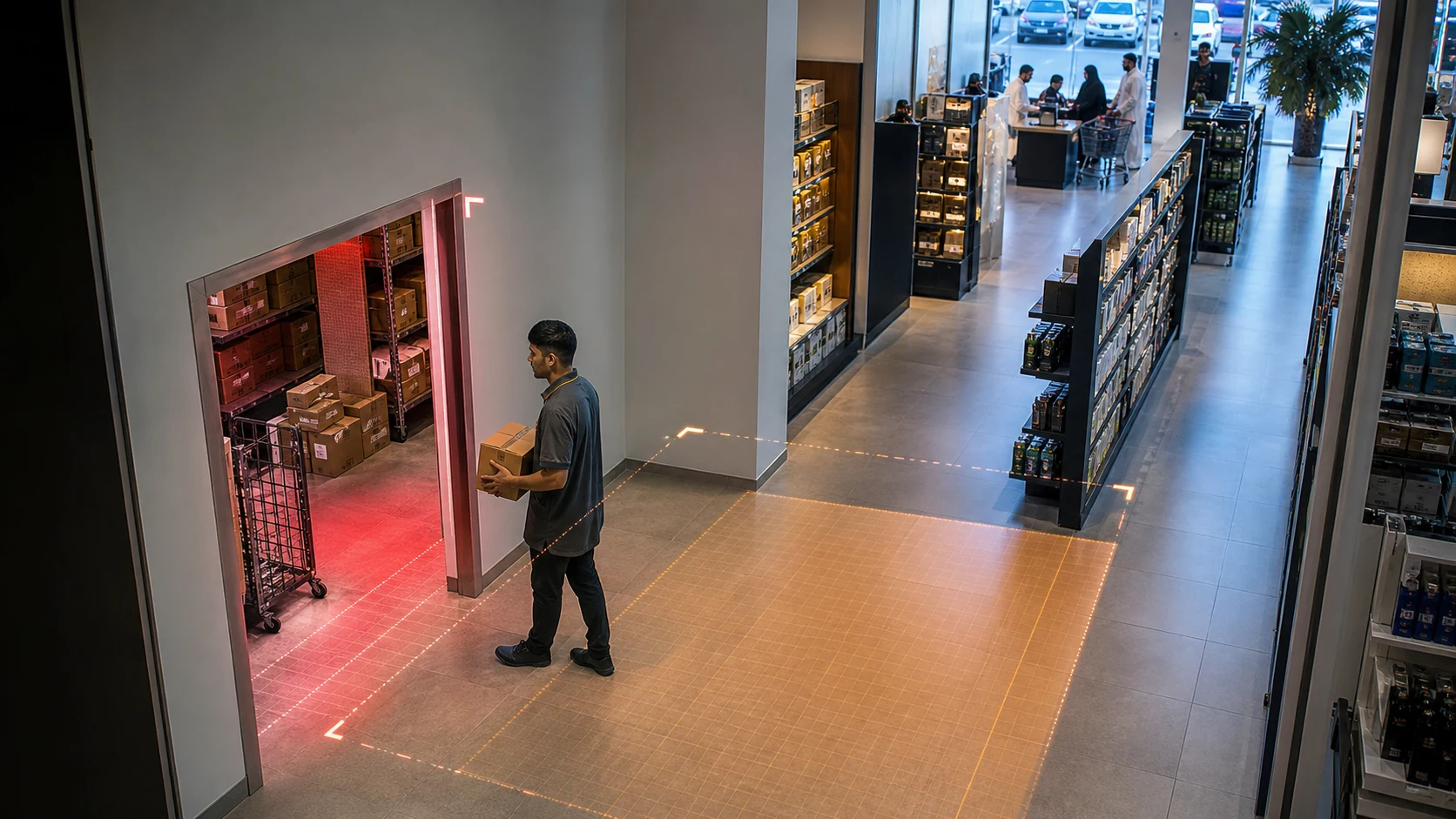
The simulated site is a mid-size supermarket or pharmacy in a Gulf shopping district. A camera already covers the transition between the shop floor and a staff-only stockroom. During a busy evening trading period, a person steps through the stockroom doorway while staff are distracted near checkout.
In Horus, that doorway is configured as a restricted zone. The simulated rule is deliberately simple: if a person enters the staff-only zone and remains inside the threshold area for 12 seconds, Horus raises a medium-severity restricted-zone alert. The aim is not to accuse a customer or replace staff judgement. The aim is to turn a risky physical event into an immediate, reviewable signal.
The Research Baseline
Retail crime is expensive even before a single item leaves the store. BRC reported that UK retailers spent GBP1.8 billion on crime prevention in 2023/24, including CCTV, security personnel, anti-theft devices, and body-worn cameras. The same benchmark reported over 55,000 theft incidents per day and more than 2,000 daily incidents of violence or abuse against retail workers.
US retail data points in the same direction. The NRF, Loss Prevention Research Council, and Sensormatic reported that shoplifting incidents in 2023 were up 93% versus 2019, and the dollar loss from shoplifting was up 90% over the same period. Zebra's global retail research adds the operator perspective: 78% of retailers are under high pressure to minimise theft and loss, 84% of associates are concerned about loss prevention, and 50% of retailers say they plan to use AI-based prescriptive analytics for loss prevention in the next one to three years.
The Middle East context matters because the physical store remains central. PwC Middle East's Voice of the Consumer 2024 found that 48% of regional consumers frequently shopped from physical stores for non-grocery products in the prior 12 months, higher than the 42% global comparison. Its Saudi findings also reported that 49% of Saudi consumers still value in-store shopping, while 40% seek convenience-enhancing technologies such as self-checkout and personalised real-time offers. That makes existing-camera intelligence relevant for Gulf operators.
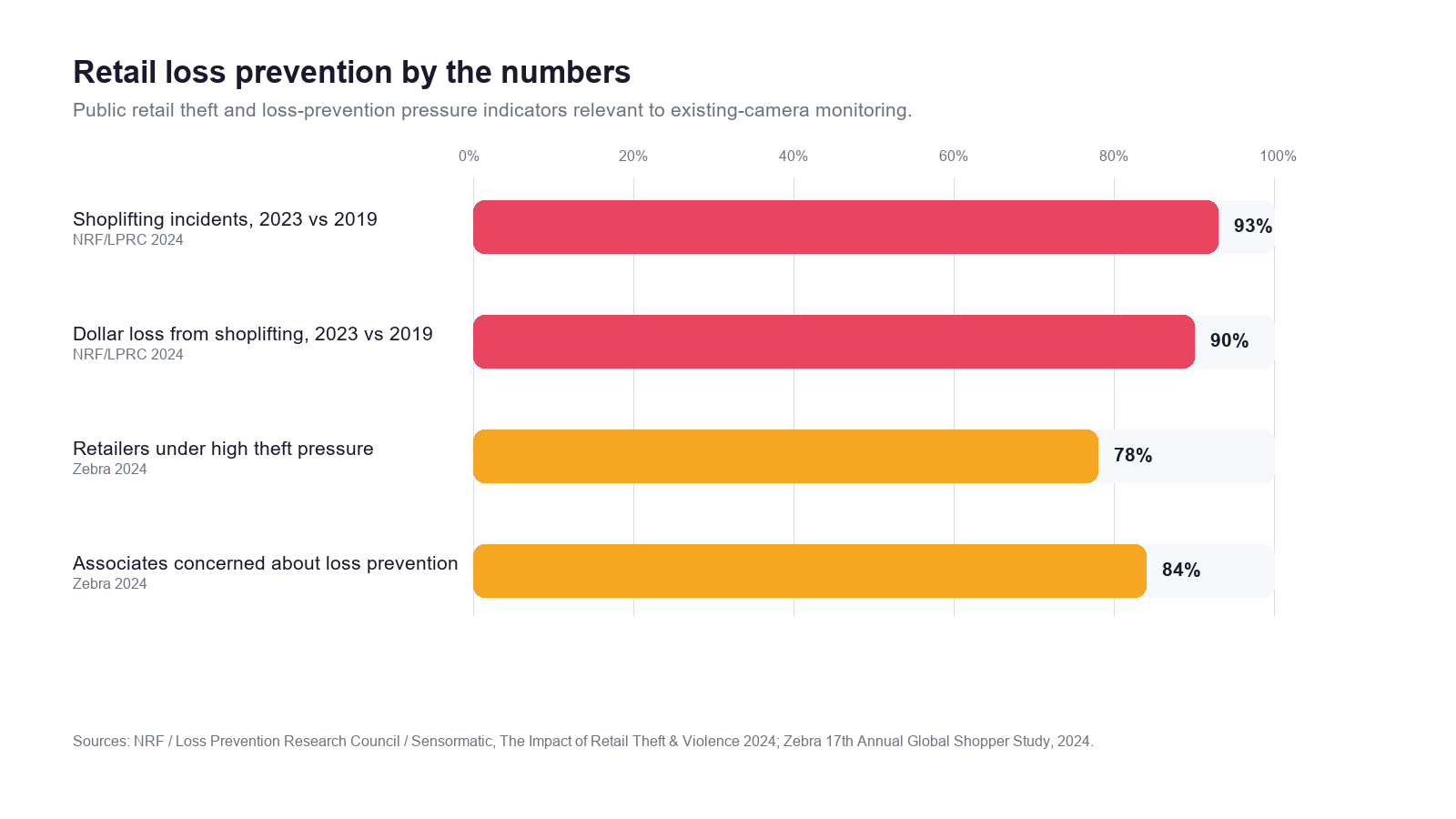
Sources: BRC Crime and Shrink Benchmark 2025, NRF 2024 retail theft and violence study release, Zebra 17th Annual Global Shopper Study, Donald 2015 CCTV vigilance study, PwC Middle East Voice of the Consumer 2024, PwC Saudi Arabia findings.
The Detection
The detection starts at the camera, not the cloud. Horus runs AI inference on the local Windows edge agent, using the store's existing IP camera feed. The cloud dashboard receives event metadata, counts, confidence scores, and optional alert snapshots. Raw video does not need to leave the site.
At 19:42:08 in the simulated walkthrough, the camera detects one person approaching the staff-only doorway. The person crosses the restricted-zone line and enters the threshold area. Horus assigns a tracked object ID and evaluates the zone rule. A single frame is not enough to trigger the alert; the rule waits for persistence so a brief pass-by or camera noise does not create unnecessary escalation.
At 19:42:20, the person has remained inside the configured staff-only zone for 12 seconds. The simulated event is recorded as:
| Time | Event | Zone | Confidence | Severity | Suggested action |
|---|---|---|---|---|---|
| 19:42:20 | Restricted-zone entry | Stockroom doorway | 0.88 | Medium | Staff check stockroom entrance |
The alert can be routed to the dashboard and, in live deployments, to Telegram or email. A supervisor does not need to watch the camera wall continuously. The job is narrower: confirm whether the entry is expected, ask a nearby staff member to check the doorway, and review the event later if inventory or safety issues are reported.
This is where AI CCTV analytics differs from standard motion detection. A motion alarm can fire because a door moves, a shadow changes, or staff pass through repeatedly. The Horus-style event uses object detection, tracking, zone geometry, confidence scoring, and alert cooldowns. For a Gulf supermarket, pharmacy, electronics shop, or mall tenant, the rule can be tuned around the actual camera view: doorway entry, high-value shelf approach, cashier back-office access, or after-hours movement.
Human monitoring still has a role, but it does not scale cleanly. A CCTV human-factors study by Donald found operators detected a mean of 55% of target behaviours during a 90-minute surveillance task. In this article's scenario model, a routine floor check might notice the breach after ten minutes, while a dedicated CCTV operator might notice after three minutes. The simulated Horus alert fires after the 12-second persistence threshold.
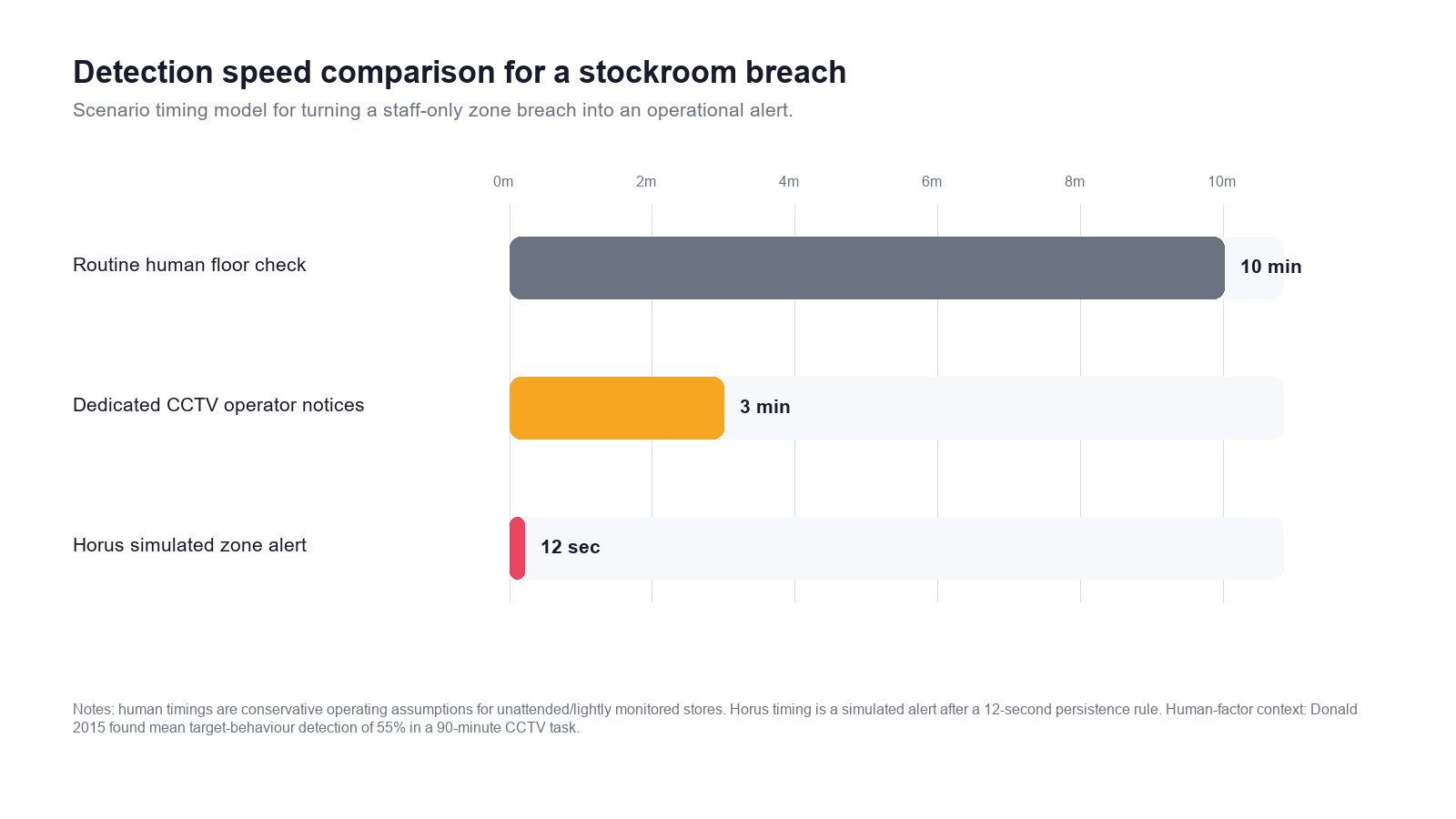
The numbers in that chart are not a universal benchmark. They are a practical operating model. The point is the response loop: a restricted-zone event is only useful if someone knows while intervention is still possible.
What This Means In Practice
For retailers, the value is not simply "catching theft." It is reducing the number of ambiguous, late, and unreviewed incidents. A store manager can search events by zone, time, confidence, or severity. An owner can ask whether stockroom alerts cluster during shift changes, evening rushes, supplier deliveries, or weekend mall peaks. A security lead can tune thresholds so staff-only areas are monitored without turning the shop floor into a false-alarm machine.
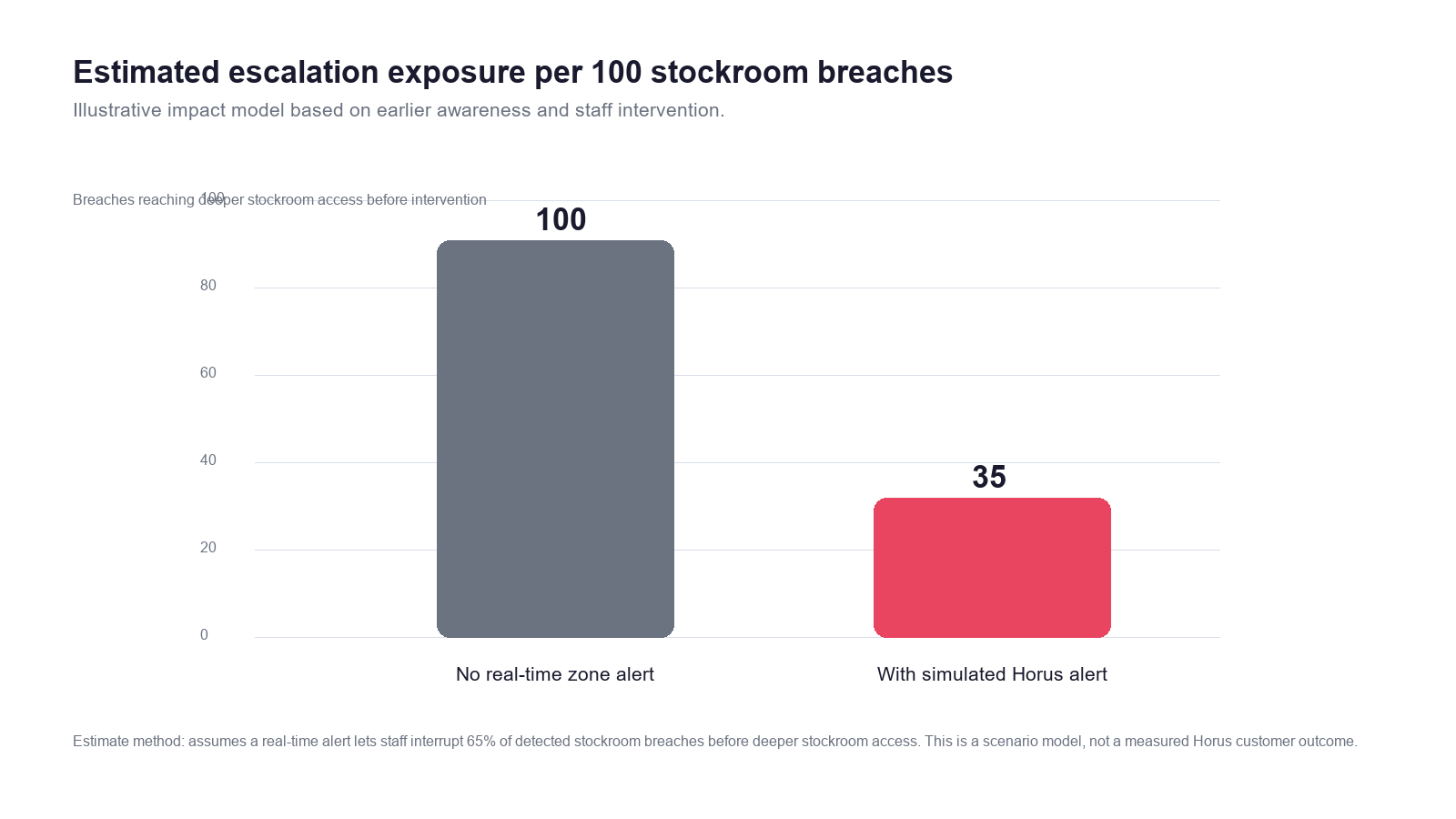
The impact estimate below is deliberately conservative. It assumes that without a real-time zone alert, 100 out of 100 stockroom breaches reach deeper access before staff intervention. With a simulated Horus alert, it assumes staff interrupt 65% before that deeper access happens, leaving 35 escalated events per 100 breach opportunities. This is not a guaranteed Horus outcome. It is a scenario model a retailer can validate in a short pilot.
Conclusion
This was a hypothetical demonstration using Horus in a simulated operational environment, not a customer case study. The loss-prevention statistics are real and cited; the stockroom event, alert timing, confidence score, and impact model are illustrative.
The practical lesson is straightforward. Retailers already spend heavily on cameras, guards, and loss-prevention controls. AI CCTV analytics makes part of that estate active: a staff-only doorway becomes a monitored zone, a threshold breach becomes an alert, and the event becomes searchable evidence for later review.
Horus plugs into existing IP cameras, runs AI locally on a Windows edge machine, and sends detection metadata and alerts without requiring new cameras or cloud video upload. For retailers in Egypt, UAE, Saudi Arabia, Kuwait, and the wider GCC/MEA region, that combination supports real-time store operations while respecting existing CCTV infrastructure.
Want to see how Horus would perform with your cameras? Book a demo at horusapp.io ->