AI Video Analytics for Warehouse Safety: A Simulated Forklift–Pedestrian Demonstration
AI video analytics can turn an unsafe interaction between a forklift and a pedestrian into a time-stamped operating signal for a safety manager to review. That matters in both US and UK warehouse environments. OSHA reported that 84 workers died in incidents involving forklifts and other powered industrial trucks in the US in 2024. HSE's provisional 2025/26 Great Britain figures record 24 worker deaths from being struck by a moving vehicle, including 15 worker deaths in transportation and storage. HSE also says lift trucks are involved in about a quarter of workplace transport accidents. These figures use different definitions and should not be added together or treated as a common rate. They do establish why pedestrian–vehicle separation remains a live safety problem. Here's what Horus detects when we simulate this scenario.
Disclaimer: This article describes a hypothetical demonstration using Horus in a simulated operational environment. All scenarios are illustrative only. The event timing, confidence scores, rule coverage, and impact estimate are not a live customer result or a measured Horus safety-performance claim.
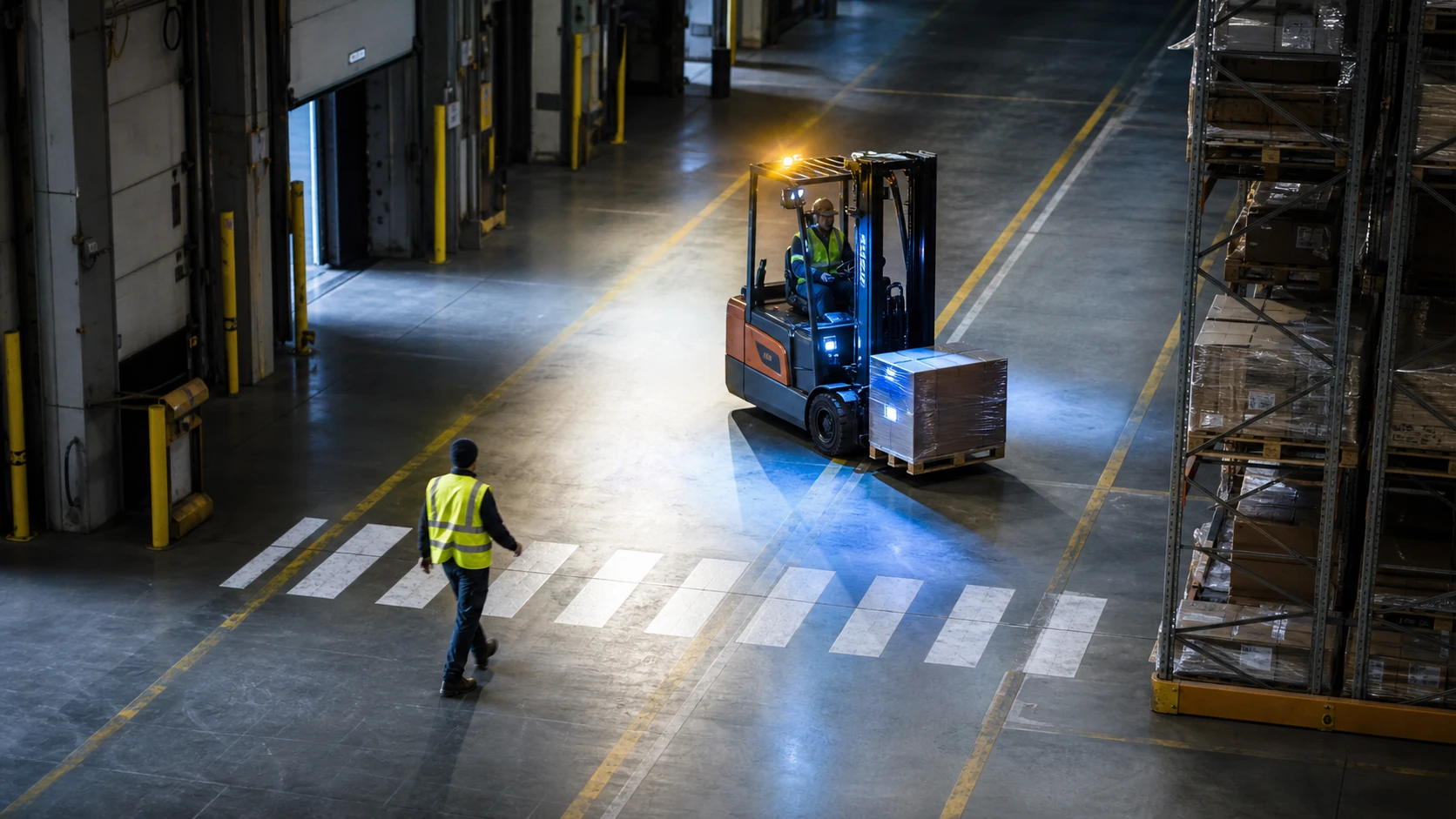
The scenario setup
The simulated site is a medium-sized warehouse with a loading dock, pallet racking, one-way forklift traffic, and a marked pedestrian crossing between the staff entrance and a picking area. The site already has an RTSP-compatible IP camera mounted above the dock door.
The operator draws a vehicle-only zone around the loading lane and a line across the pedestrian crossing. The walkthrough rule is: when a tracked person crosses into the vehicle-only zone while a tracked forklift is present, persist the condition for 5 seconds, then create a high-severity safety-zone event. A cooldown prevents repeated alerts while the same exposure continues.
Validate this compound rule in a real pilot; it is not necessarily preconfigured.
The research baseline
US and UK regulators point to the same operational issue through different measurement systems:
- OSHA's June 2026 forklift-safety remarks cite the latest BLS data: 84 workers died in incidents involving forklifts and other powered industrial trucks in 2024.
- HSE's current Great Britain fatal-injury summary records 24 worker deaths classified as struck by a moving vehicle in provisional 2025/26 RIDDOR data, and 15 worker deaths in transportation and storage.
- HSE's lift-truck guidance says lift trucks are involved in about a quarter of all workplace transport accidents. That is a share of accidents, not a prediction for any particular warehouse.
- HSE's workplace-transport guidance tells employers to map pedestrian and vehicle movements, reduce contact between them, provide separate routes where possible, and use appropriate crossing points. CCTV is one possible reversing aid; it is not a substitute for traffic design or supervision.
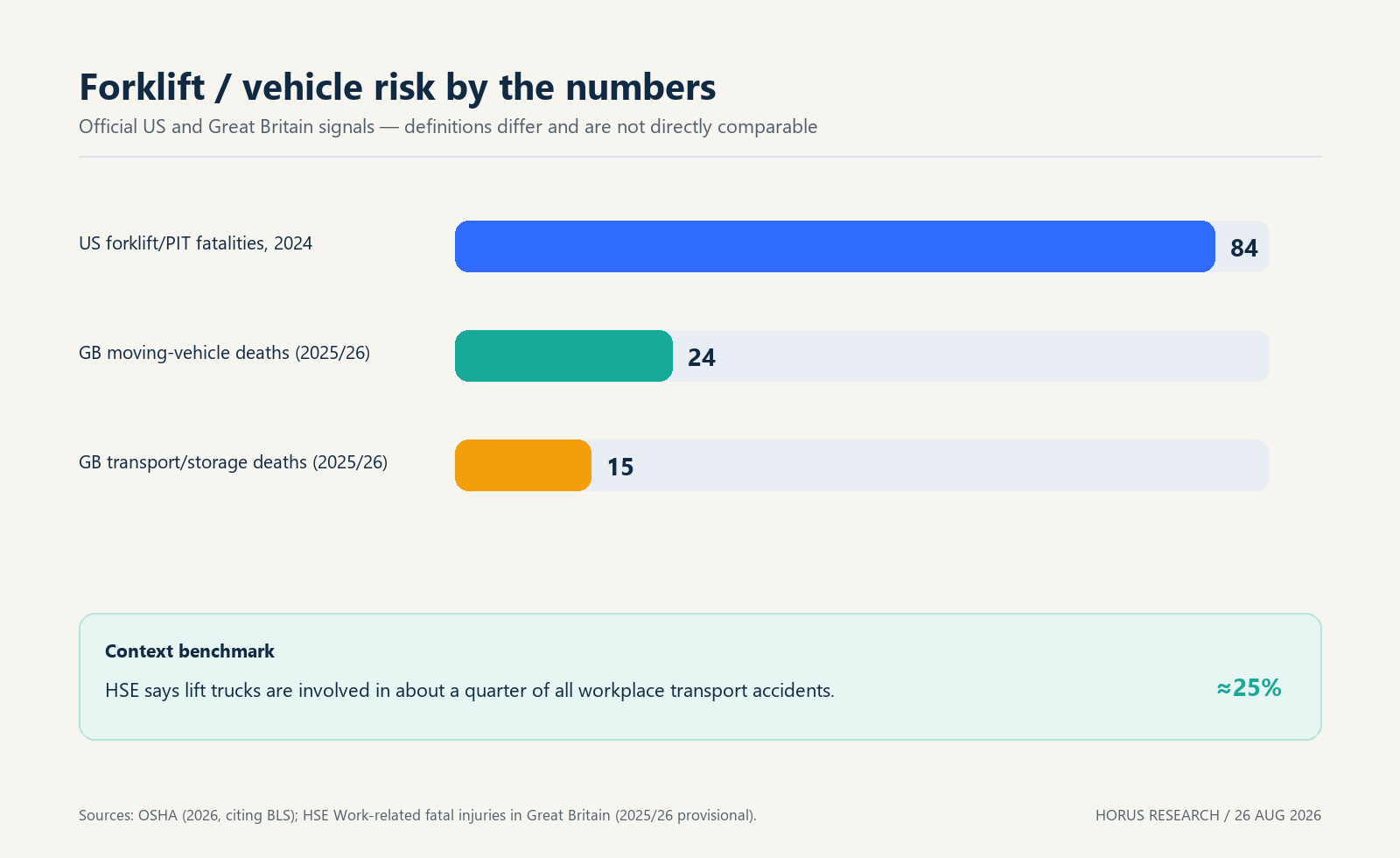
The datasets are not interchangeable. The OSHA figure is a US fatality count for forklifts and other powered industrial trucks. The HSE figures are Great Britain RIDDOR categories, and the transportation-and-storage number is an industry total rather than a forklift total. Treating them as a single trend would create false precision. The useful conclusion is narrower: both regulators continue to identify moving vehicles, lift trucks, and the interaction between people and vehicles as material workplace risks.
Sources: OSHA Industrial Truck Association National Forklift Safety Day remarks, HSE Work-related fatal injuries in Great Britain, HSE Managing lift trucks, and HSE Introduction to workplace transport safety.
The detection walkthrough
The detection begins on the local Windows edge machine. Horus processes the camera stream on site, identifies people and vehicles, assigns tracking IDs, and evaluates the configured line and zone conditions.
At 14:22:01 in the simulated walkthrough, the forklift is detected inside the loading lane with a hypothetical confidence score of 0.94. A worker is visible on the pedestrian side of the crossing at 0.91. Both tracks are normal activity, so no event is created.
At 14:22:07, the worker crosses the marked line. The tracked person is now inside the vehicle-only zone while the forklift remains present. The rule starts its persistence timer. This delay is intentional: a person touching the line for a single frame, a worker walking behind a pillar, or a forklift leaving the frame should not automatically become a high-severity event.
At 14:22:12, the condition has persisted for five seconds. The simulated event is:
| Time | Event | Zone | Tracks | Confidence | Severity | Suggested action |
|---|---|---|---|---|---|---|
| 14:22:12 | Pedestrian in vehicle-only zone with forklift present | Loading dock lane | Person P-17 + forklift V-03 | 0.91 / 0.94 | High | Stop movement, verify separation, review crossing controls |
That event prompts a trained person to intervene. It does not brake the forklift, identify fault, determine intent, or declare that an injury was prevented. The safety manager or shift lead still decides whether to pause traffic, check controls, or investigate why the pedestrian route was not used.
The alert is useful because it captures the interaction, not just either object. A people counter records one person, a vehicle counter records one forklift, and a simple line-crossing rule records a crossing. The operational question is more specific: did a person enter a vehicle-only zone while a moving industrial vehicle was there? The event timeline preserves that context for immediate review and later safety analysis.
The same pattern can be tested around a reversing bay, trailer loading area, or pallet aisle when the camera angle makes the zone visible. Site teams should test occlusion, lighting, camera height, shift patterns, and normal crossing behavior before choosing a threshold. A rule that is too sensitive creates alert fatigue; one that is too loose may miss the intervention window.
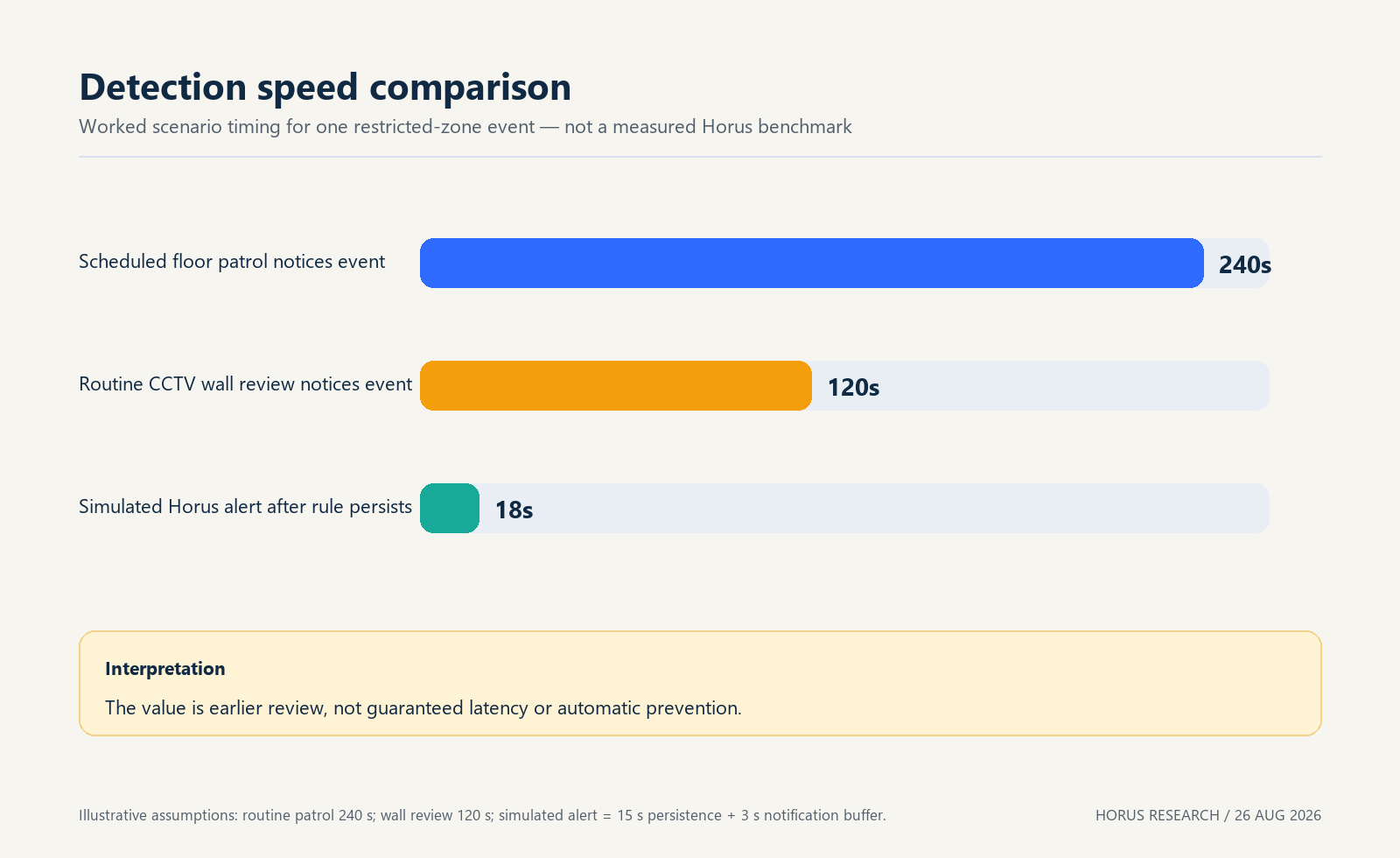
The timing chart is a worked scenario, not a universal performance benchmark. It compares a 4-minute wait for a scheduled floor patrol, a 2-minute wait for routine CCTV-wall review, and an 18-second simulated alert made up of the five-second persistence rule plus a three-second notification buffer. The point is not that every Horus installation will produce 18-second alerts. The point is that an explicit zone rule can make the review window visible before the next scheduled observation.
What the impact estimate means
The third chart normalizes the HSE benchmark into a simple review-workload model. Start with 100 modelled workplace-transport events. Applying HSE's approximate 25% lift-truck share produces 25 lift-truck-associated events. If a configured pilot rule surfaces 80% of those exposures, the team receives 20 early-review opportunities and five remain outside this rule.
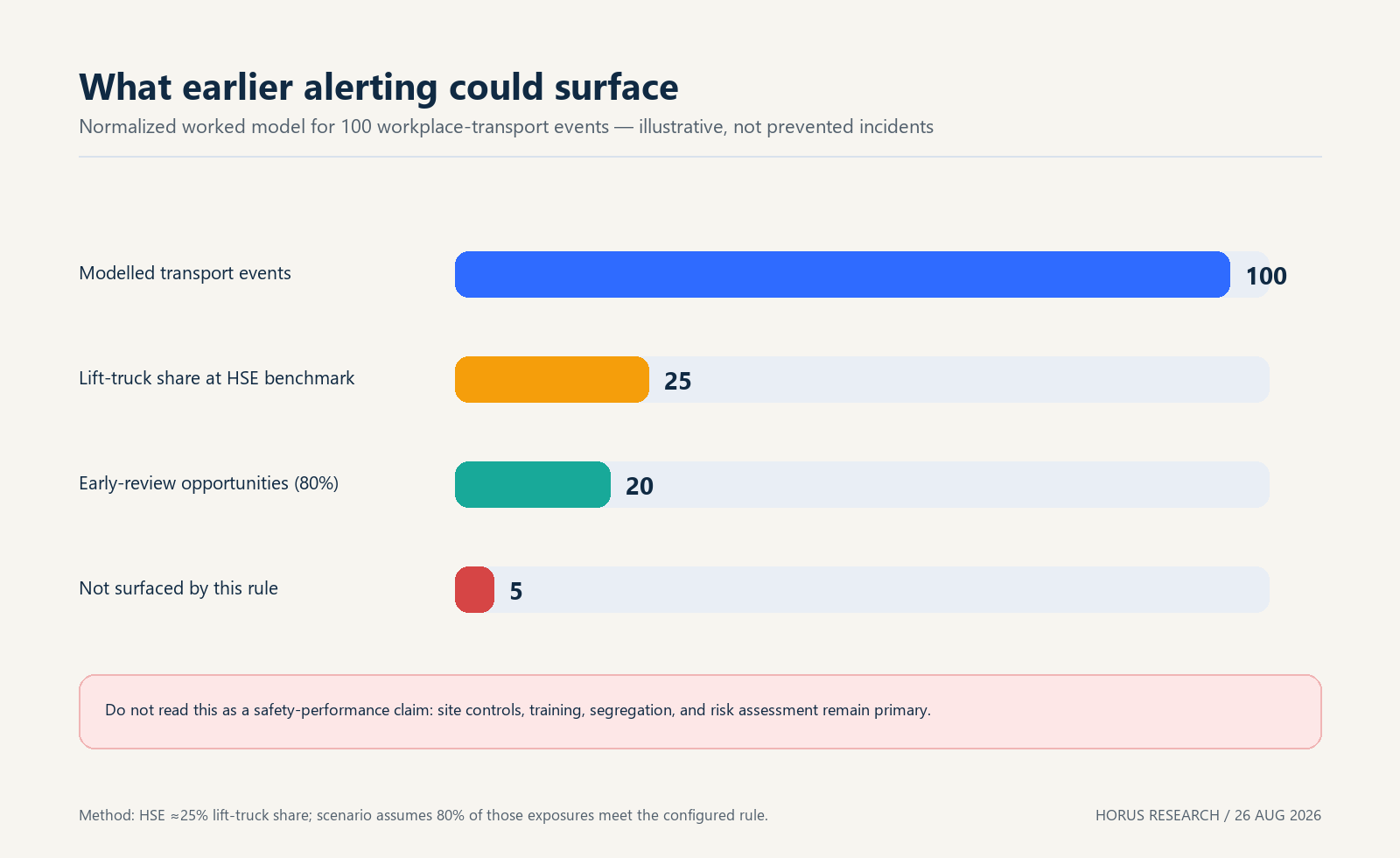
The 80% coverage assumption is hypothetical. It is not a Horus accuracy claim, and the 20 opportunities are not 20 prevented injuries. They are a way to define a pilot measurement: how many relevant exposures were visible in the camera view, how many met the rule, how many alerts were actionable, and how many were missed because of occlusion, threshold choice, or a route outside the camera's field of view.
What this means in practice
AI video analytics works best here as a leading-indicator layer around an existing safety system. It can help a team find repeated zone crossings, compare events by shift, and identify where a barrier, route, sign, mirror, light, or training step deserves attention. It cannot replace a risk assessment, physical segregation, trained forklift operators, banksmen where needed, or a safe traffic plan.
For a practical pilot, start with one loading-dock camera and one narrowly defined condition. Record blind spots, name the alert recipient and first response, then review false positives for a week before adjusting the line, persistence window, severity, or cooldown.
Horus plugs into existing IP cameras, runs inference locally on a Windows PC, and provides zone analytics, line-crossing detection, confidence scoring, and configurable alerts without requiring new cameras or uploading raw video to the cloud. For US and UK buyers researching AI video analytics, warehouse camera analytics, or CCTV analytics, that makes the first question concrete: can the existing camera see the interaction clearly enough to support a useful operational rule?
Conclusion
This was a hypothetical demonstration using Horus in a simulated operational environment, not a customer case study. The OSHA and HSE statistics are real and source-linked; the forklift tracks, confidence scores, alert timing, rule coverage, and impact model are illustrative.
The practical lesson is simple: warehouse safety depends on keeping people and moving vehicles apart, while many near-miss conditions occur in the seconds between routine checks. A carefully scoped CCTV analytics rule can make that interaction reviewable earlier, but only as part of a wider safety system built on segregation, training, supervision, and continuous risk assessment.
Want to see how Horus would perform with your cameras? Book a demo at horusapp.io →