CCTV Analytics for Retail Queue Overflow: A Horus Simulated Demonstration
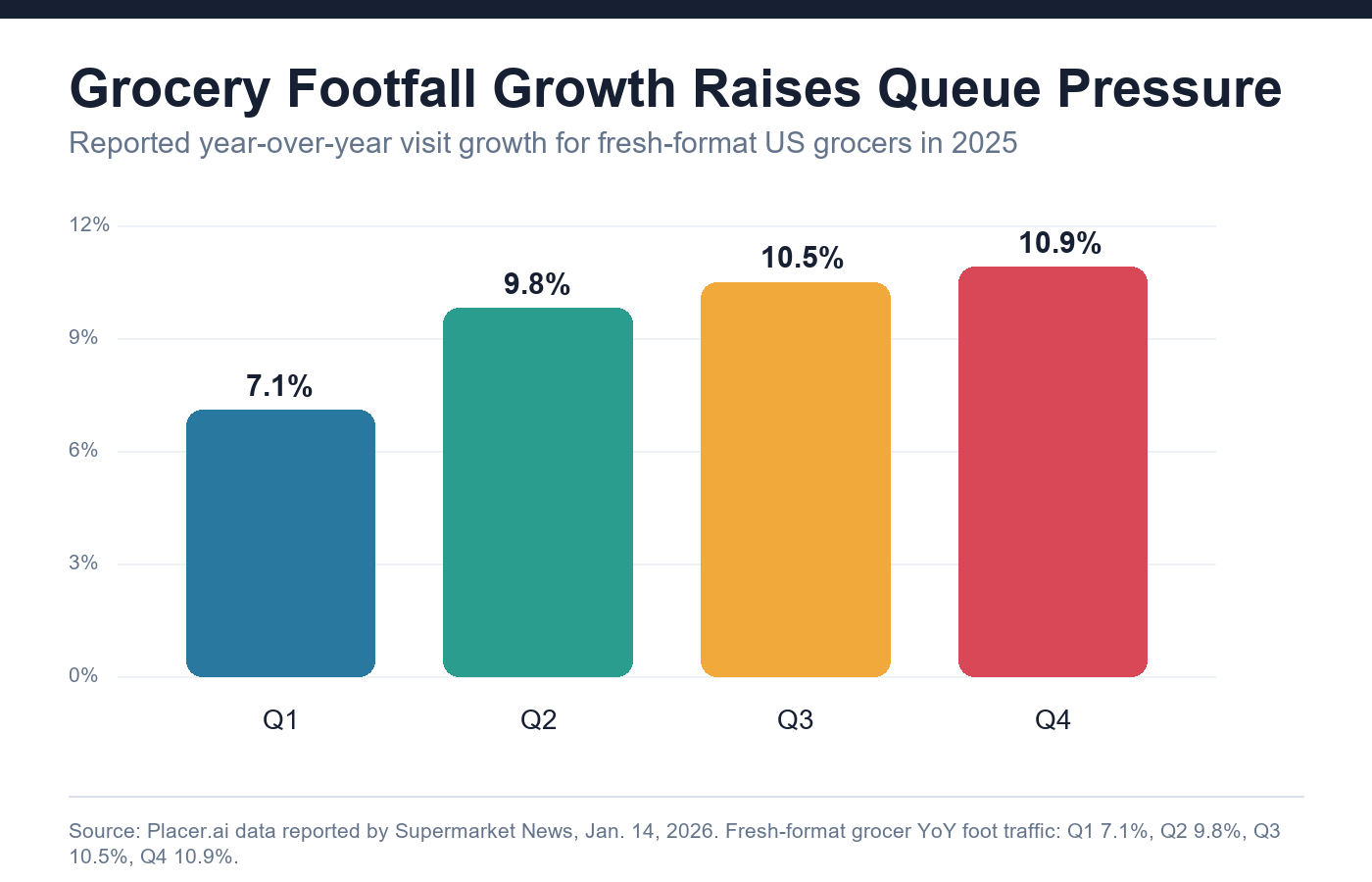
CCTV analytics can turn a checkout queue from something staff notice late into a measurable operating signal. In retail, that matters because physical stores are still carrying real demand: Colliers reported that US retail foot traffic rose 2.8% year over year in December 2025, while Placer.ai data reported by Supermarket News showed fresh-format grocers posting 10.9% year-over-year foot traffic growth in Q4 2025. In the UK, the BRC-Sensormatic Footfall Monitor tracks more than 40 billion shopper visits annually across 1.5 million measurement devices, underlining how central footfall remains to retail performance.
Queue pressure is not just an inconvenience. FMI's 2026 US grocery research found that 69% of grocery shoppers want an easy shopping experience, while peer-reviewed retail queue research has shown that queue length can worsen customer experience and perceptions of service quality. Here's what Horus detects when we simulate this scenario.
Disclaimer: This article describes a hypothetical demonstration using Horus in a simulated operational environment. All scenarios are illustrative only. The queue, alert timing, confidence score, and impact estimate below are not presented as a live customer case study or measured Horus deployment result.
The Scenario Setup
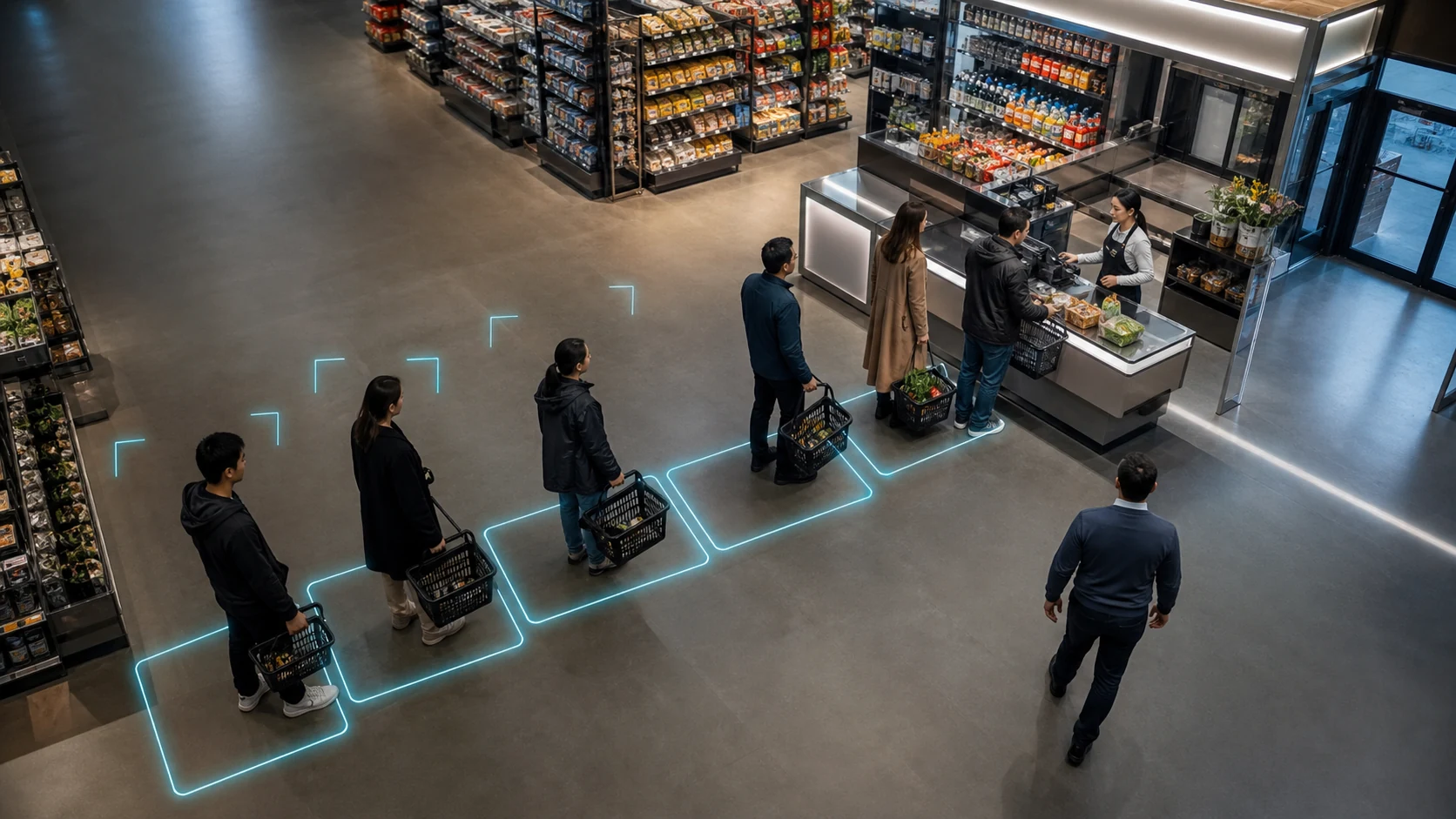
The simulated site is a small-format grocery store with one main checkout lane and one backup lane. The store already has an IP camera mounted above the entrance-side corner, looking across the checkout area and first aisle. No new camera is added.
In Horus, the operator draws a queue zone behind the primary checkout. The simulated rule is simple: if five or more tracked people remain inside the queue zone for at least 15 seconds, Horus raises a medium-severity queue overflow alert. The rule is designed to avoid noise from shoppers walking past the checkout, while still surfacing a queue before it becomes a visible service problem.
The Research Baseline
Retail queues become important when footfall returns or shifts unevenly by format. Supermarket News reported Placer.ai data showing fresh-format grocers growing visits by 7.1% in Q1 2025, 9.8% in Q2, 10.5% in Q3, and 10.9% in Q4. Checkout staffing often changes in blocks, while customer arrivals change minute by minute.
The UK evidence points to the same operational need from a different angle. The BRC-Sensormatic Footfall Monitor describes itself as a representative UK retail-store footfall indicator, drawing on 1.5 million measurement devices and more than 40 billion shopper visits each year. Retailers already treat footfall as a management signal. The gap is that many smaller stores still see checkout congestion only after a supervisor walks past, a customer complains, or sales data shows a soft conversion period later.
The customer-experience evidence is also strong enough to justify monitoring queues as an operational risk. In FMI's 2026 US grocery shopper research, 54% of grocery shoppers always shop in-store at their primary store, and 69% said they want an easy shopping experience. A 2018 Journal of Retailing paper found that customers' experiences deteriorate as queue length increases, with social pressure mediating the effect. The same paper cites earlier consumer research indicating that among shoppers unwilling to wait, 32% would buy through online retailers and 18% would visit another store.
Those figures are not a direct forecast for every grocery site. A convenience store, supermarket, and pharmacy will have different queue tolerance, basket value, and staffing constraints. The useful takeaway is narrower: visible queue length changes behavior, and CCTV analytics can measure it in real time.
Sources: BRC-Sensormatic Footfall Monitor, Colliers US Retail Monthly Foot Traffic & Sales Analysis, December 2025, Supermarket News reporting Placer.ai grocery foot traffic data, FMI 2026 US Grocery Shopper Trends, Journal of Retailing queue research.
The Detection
The detection begins with the camera feed on the local Windows edge machine. Horus processes video locally, detects people, tracks them through the frame, and evaluates whether each tracked person is inside the configured queue zone. The cloud side receives event metadata and analytics, not raw video.
At 17:36:04 in the simulated walkthrough, three shoppers are inside the checkout queue zone. That is recorded as normal activity. No alert fires because the queue is within the store's chosen operating threshold.
At 17:36:41, two more shoppers join. Horus now sees five tracked people inside the queue zone, but the system still waits for persistence. This matters in real stores: a person cutting across the checkout area, a staff member walking past the tills, or a shopper briefly entering the zone should not create an operational alert.
At 17:36:56, the five-person threshold has persisted for 15 seconds. The simulated event is recorded as:
| Time | Event | Zone | Count | Confidence | Severity | Suggested action |
|---|---|---|---|---|---|---|
| 17:36:56 | Queue overflow | Main checkout lane | 5 people | 0.91 | Medium | Open backup lane or send floor support |
The alert route is practical. A manager does not need to stare at a camera wall. Horus can surface the event in the dashboard and, in live deployments, route alerts through Telegram or email. The person receiving the alert still decides what to do: open the backup lane, move a trained floor colleague to checkout, troubleshoot a POS delay, or let the queue clear naturally if staff are already responding.
This is where CCTV analytics differs from a basic people counter. A door counter tells the retailer how many people entered. A POS report tells the retailer what sold later. A queue zone tells the retailer what is happening when service capacity becomes constrained. For operators, the useful signal is not just "busy." It is "five shoppers have waited in this checkout zone long enough to need a staff decision."
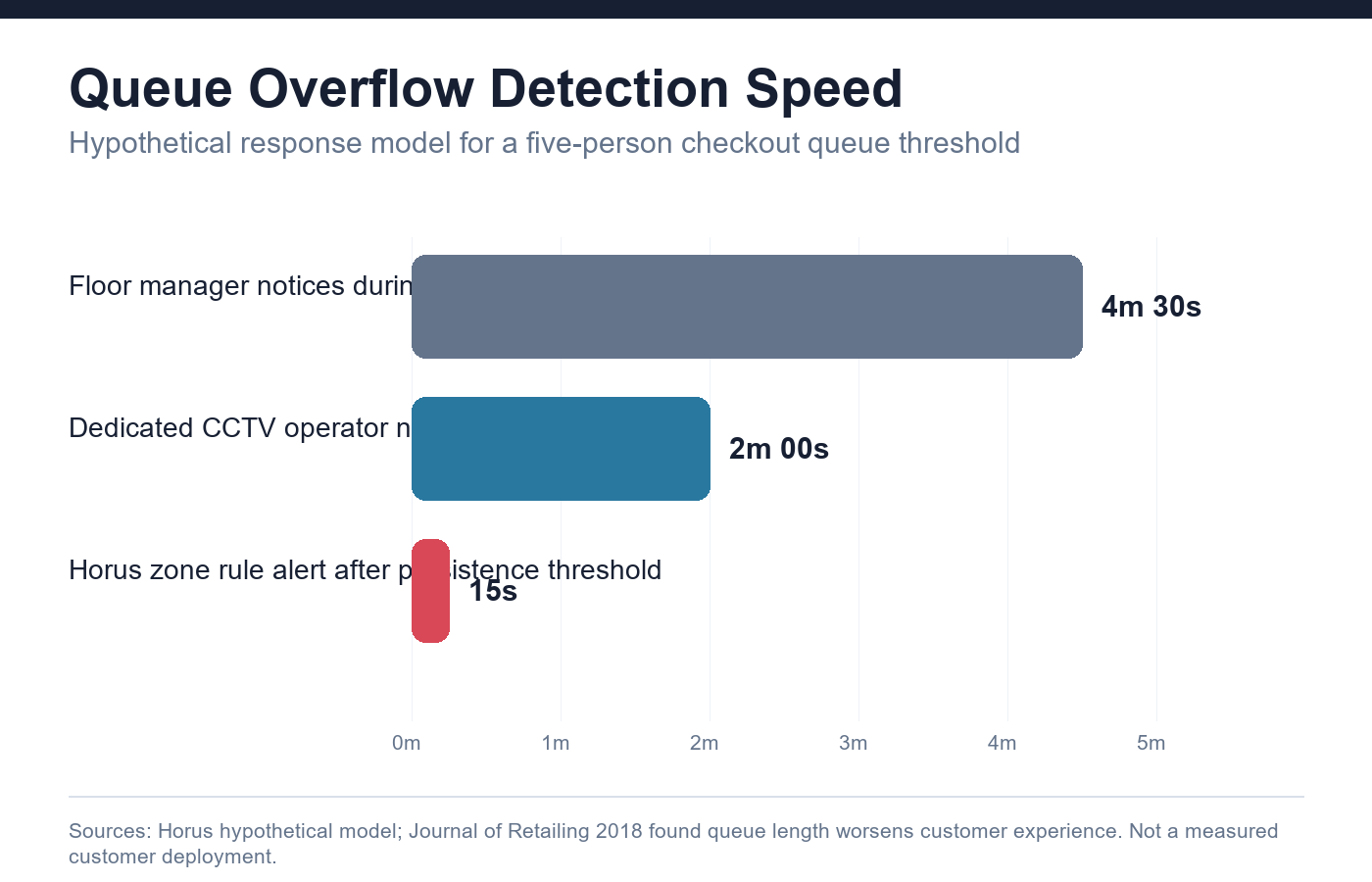
The timing comparison above is a scenario model, not a universal benchmark. It assumes a floor manager notices during a routine pass after 4.5 minutes, a dedicated CCTV operator notices after 2 minutes, and Horus triggers after a 15-second persistence threshold. AI does not remove judgement; it compresses the time between a measurable queue condition and a staff decision.
Alert cooldowns can also prevent repeated notifications while a queue remains above threshold. When the queue falls below threshold, the event can close and the site can later review duration, peak periods, and staffing patterns.
What This Means In Practice
Queue analytics is valuable when it improves decisions the team can act on. A store with one checkout may only need a manager alert at six people. A supermarket may want separate thresholds for self-checkout, returns, and staffed lanes. A pharmacy may care more about the service desk queue than the general checkout.
The impact estimate below uses a conservative worked model, not a Horus performance guarantee. It starts with 1,000 peak-period shoppers. It assumes 10% encounter a visible long queue. Using the 32% online-purchase displacement figure cited in the Journal of Retailing paper as a behavioral risk input, that creates 32 potentially displaced baskets. The final bar assumes alert-led staff intervention cuts that risk by a little over half, leaving 14 potentially displaced baskets.
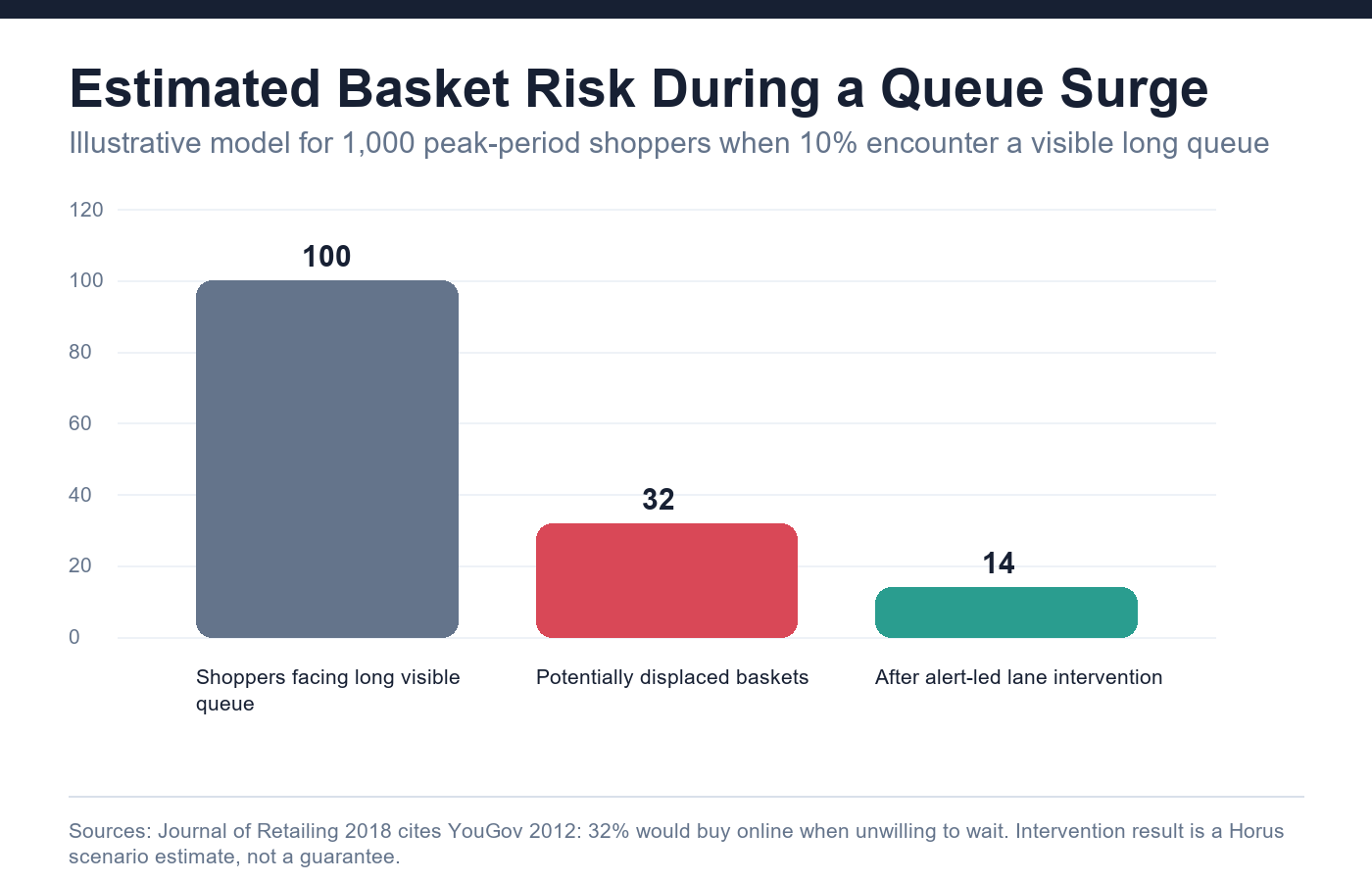
That model is intentionally simple so a retailer can replace the assumptions with their own numbers: peak footfall, observed queue frequency, basket value, staff availability, and how often a backup lane can realistically open. The first 14-day trial question is not "what is the universal ROI of AI?" It is "how often does this happen on our cameras, and how quickly can our team respond?"
Horus plugs into existing IP cameras, runs AI locally on a Windows edge machine, and sends detection metadata and alerts without requiring new cameras or cloud video upload. For US and UK retail buyers comparing CCTV analytics, people counting, retail footfall analytics, and queue monitoring systems, that keeps the demonstration grounded in the camera estate they already have. Existing MEA/Gulf and Arabic assets remain supported as secondary tracks, but this article is written for market-neutral English search demand first.
Conclusion
This was a hypothetical demonstration using Horus in a simulated operational environment, not a customer case study. The retail footfall, grocery shopper, and queue-behavior statistics are real and cited; the queue event, alert timing, confidence score, and basket-risk model are illustrative.
The practical lesson is straightforward. Retailers already measure footfall because physical traffic still matters. CCTV analytics makes the next layer measurable: when a queue forms, how long it persists, where it forms, and whether the team responds while the customer experience can still be protected.
Want to see how Horus would perform with your cameras? Book a demo at horusapp.io ->