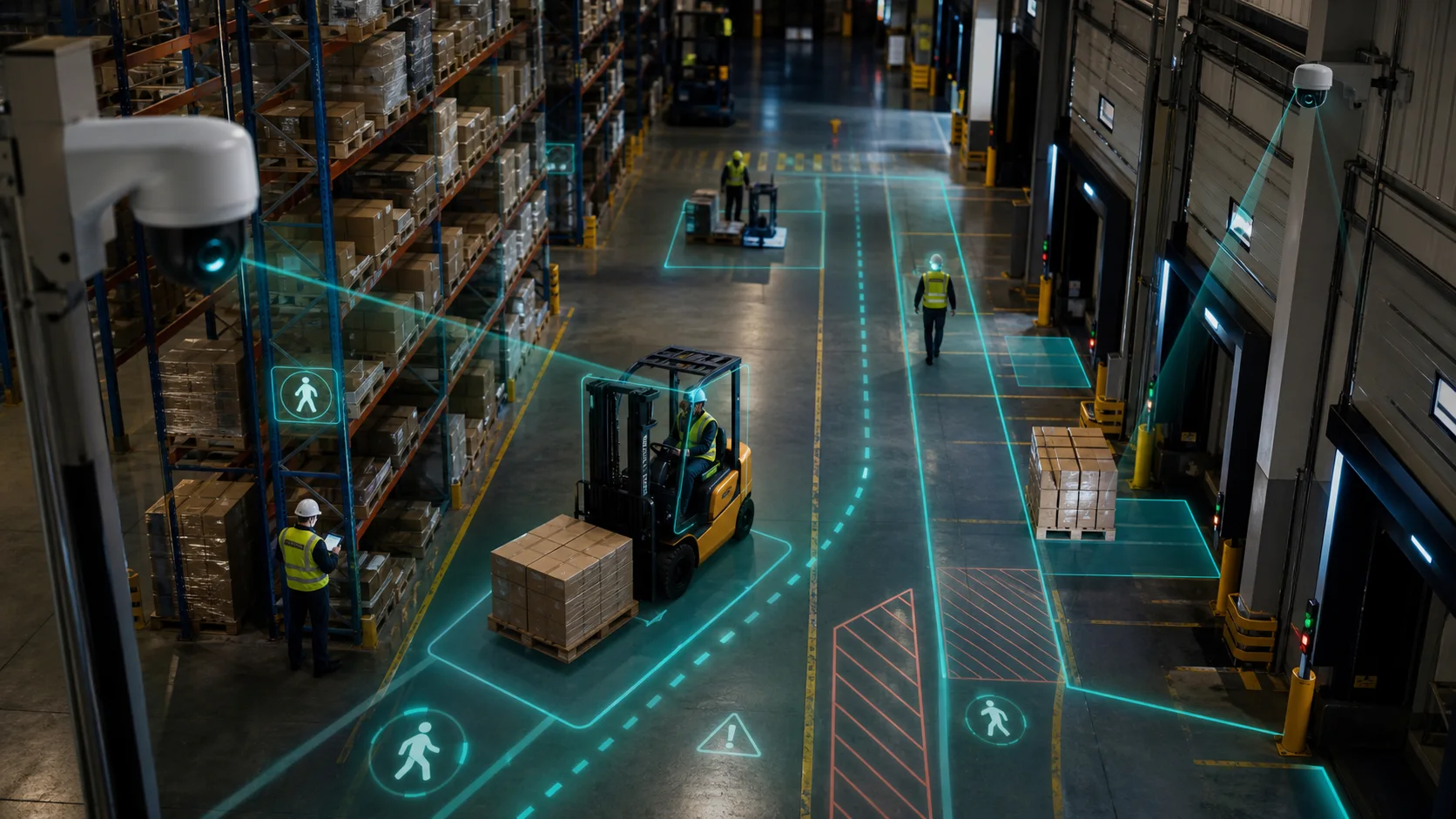
Video Analytics for Warehouse Safety
Video analytics for warehouse safety uses AI to read existing camera feeds, detect unsafe events, and alert supervisors while there is still time to intervene. The best warehouse setup monitors forklift lanes, loading docks, PPE zones, restricted areas, and blocked exits without requiring workers to manually watch every CCTV screen.
Most warehouses already have cameras. The gap is that those cameras usually become useful after an incident, not before it. AI video analytics turns them into a real-time safety layer.
Quick answer: how warehouse safety analytics should start
The safest first warehouse analytics rollout starts with existing CCTV, three to five clear camera views, and alert rules for events supervisors can act on immediately: PPE missing in required zones, people entering forklift lanes, restricted storage access, loading dock movement, and blocked exits. Horus processes these detections on a local Windows edge machine, so raw warehouse video stays on-site while alerts and event metadata reach the dashboard.
What does video analytics for warehouse safety detect?
Warehouse safety analytics should focus on events that a supervisor can act on quickly. Useful detections include:
- People entering forklift lanes or loading dock zones
- Missing hard hats, safety vests, or other PPE
- Restricted-zone entry near high racks, machinery, chemicals, or inventory cages
- Loitering or unusual after-hours movement
- Blocked walkways, exits, or housekeeping hazards
- Vehicle movement through defined yard or dock zones
- Line crossing at entrances, gates, cages, or loading bays
- Occupancy in areas that should stay clear during active operations
Some platforms also detect falls, smoke, fire, or ergonomic risks. Those are valuable where the models are reliable and the business has a clear response process. For most SMB and mid-market warehouses, the first phase should start with the highest-confidence alerts: zone entry, line crossing, PPE, vehicle movement, and restricted-area monitoring.
Why are warehouse cameras underused today?
Traditional CCTV records what happened. That helps with insurance claims, investigations, and post-incident reviews, but it does not stop the near miss.
The problem is human attention. A warehouse manager cannot watch every aisle, gate, yard, dock, and storage zone at once. A guard may miss a short event while checking another camera. A safety manager may only see risky behavior during audits, not during the busy shift where it actually happens.
That is why the strongest warehouse safety use case is not "more video." It is earlier signal. When a worker enters a forklift path, a person walks into a restricted loading bay, or PPE is missing in a marked zone, the system should produce a clear alert that names the camera, zone, event type, and severity.
How does AI video analytics work with existing warehouse CCTV?
AI video analytics connects to IP camera feeds, reads the scene in real time, and checks what it sees against rules set by the warehouse team. Those rules are usually zone based.
A warehouse might define:
- A loading dock exclusion zone during vehicle movement.
- A pedestrian-only walkway.
- A forklift lane.
- A PPE-required area.
- A restricted storage cage.
- An after-hours perimeter zone.
When a person, vehicle, or object crosses the rule, the system creates an event. The event can trigger a phone alert, dashboard item, email notification, or report entry.
Horus is designed around this existing-camera model. The Windows edge agent connects to existing IP camera streams, processes detections locally, and sends metadata, counts, and alerts to the cloud dashboard. The raw video stays on the customer's premises.
That matters for warehouses in Egypt, UAE, Saudi Arabia, Kuwait, and the wider GCC because many facilities already have Hikvision, Dahua, Axis, or mixed CCTV estates installed by local integrators. A practical AI rollout should add intelligence to those cameras, not force a full camera replacement before the first safety result is proven.
Which warehouse safety use cases should come first?
Start with events where the camera angle is clear and the response is obvious.
| Use case | Camera zone | Alert condition | Manager action |
|---|---|---|---|
| Forklift lane safety | Painted vehicle lane | Person detected in lane for 5+ seconds | Supervisor checks lane and pauses movement if needed |
| Loading dock control | Dock door and bay edge | Person or vehicle enters during restricted period | Dock lead verifies activity |
| PPE compliance | Packing, loading, or production-adjacent zone | Worker missing vest or hard hat | Shift lead corrects PPE immediately |
| Restricted storage | Cage, chemical store, high-value inventory | Person enters outside approved hours | Security or manager responds |
| Exit and walkway visibility | Fire exit or pedestrian walkway | Object/person blocks path for defined time | Floor team clears path |
This is a better starting point than trying to monitor every possible hazard from day one. A safety system that sends fewer, clearer alerts gets adopted faster than a system that overwhelms the floor team.
What does the ROI case look like?
The ROI case for warehouse safety analytics comes from fewer serious incidents, faster response, cleaner investigations, and better behavior data.
Use a simple scenario:
- A warehouse has 12 existing IP cameras.
- Three cameras cover loading docks.
- Two cameras cover forklift/pedestrian conflict zones.
- One camera covers a PPE-required area.
- Two cameras cover restricted inventory or chemical storage.
The first pilot does not need all 12 cameras. Start with four. If the system prevents one serious forklift near miss from becoming an injury, or gives the safety manager repeat evidence that a specific zone layout is causing risk, the value is already visible.
IntelliSee's warehouse safety article cites industry data showing high injury exposure in warehousing and highlights forklift and fall risks. Protex AI's warehouse guide also emphasizes near-miss capture: many near misses go unreported, and computer vision can help reveal patterns before harm occurs. That near-miss data is the practical win. The warehouse can improve the process before the incident report exists.
How should warehouses avoid false alarms?
False positives are the fastest way to kill a safety analytics rollout. If supervisors receive alerts for shadows, parked forklifts, staff walking in safe areas, or normal loading activity, they will stop trusting the system.
Use four controls:
- Tight zones
Draw zones only around the risky area. Do not monitor the whole camera frame if only the dock edge matters.
- Time windows
Some alerts only matter after hours or during active loading. If the rule runs all day, it may create noise.
- Confidence thresholds
Higher confidence thresholds reduce weak detections. Lower thresholds may be useful for counting or soft analytics, but safety alerts need trust.
- Cooldowns
If one worker stands in a zone for 30 seconds, the system should not send 30 identical alerts. Cooldown rules keep alerts usable.
Horus supports zone analytics, confidence scoring, severity levels, and alert cooldowns, so the warehouse can tune each rule instead of treating all detections the same way.
What privacy controls matter for warehouse teams?
Employee monitoring is sensitive. A warehouse safety program should be clear that the purpose is risk reduction, not hidden worker surveillance.
Use these principles:
- Tell staff which areas are monitored and why.
- Monitor zones and event types, not personal identity.
- Avoid facial recognition unless there is a specific approved use case and legal basis.
- Limit dashboard access to named users.
- Keep raw video local where possible.
- Use event metadata and short clips only when needed for response or review.
- Review the CCTV/privacy notice before adding AI.
Protex AI's warehouse guide specifically recommends reviewing data protection impact assessments when adding computer vision to existing CCTV. That is good practice even outside Europe. In MEA and Gulf procurement, privacy architecture can also become a commercial differentiator for multinational clients and regulated operators.
Horus's architecture supports this position: AI runs on-premise, video stays on-site, and the dashboard works with alerts, metadata, counts, and optional snapshots rather than continuous raw video upload.
How should a 30-day warehouse safety pilot work?
A good pilot is narrow, measurable, and tied to a real operating problem.
Week 1: camera and zone setup
- Select 3-5 cameras with clear views.
- Define forklift, dock, PPE, and restricted zones.
- Set alert thresholds and cooldowns.
- Confirm who receives alerts.
Week 2: silent validation
- Run detections without broad staff escalation.
- Review event quality daily.
- Remove noisy zones.
- Adjust thresholds and camera angles.
Week 3: supervisor response
- Turn on alerts for the best rules.
- Track response time.
- Record whether alerts were useful, false, or missed.
- Discuss repeated events with shift leads.
Week 4: decision review
- Count true alerts, false alerts, and missed events.
- Identify top recurring zones.
- Decide which rules should scale.
- Create a short safety action plan from the data.
The goal is not to prove that AI can detect everything. The goal is to prove that a few camera zones can create safer behavior and faster response without disrupting operations.
How does Horus fit warehouse safety analytics?
Horus is AI video analytics software for existing cameras. For warehouse camera analytics, Horus supports loading dock monitoring, storage area occupancy, vehicle turnaround signals, worker productivity by zone, asset movement tracking, intrusion detection, line crossing, dwell time, PPE detection, and real-time alerts.
That makes it a practical fit for SMB and mid-market warehouses that already have CCTV and need safety visibility without a full enterprise VMS project. A local CCTV installer or operations team can start with existing cameras, draw the relevant zones, and tune alerts around the warehouse's actual risk map.
If your first priority is loading bay activity, start with loading dock analytics. If your first priority is worker safety, start with PPE, forklift lane, and restricted-zone rules.
The best safety system is not the one with the longest feature list. It is the one your supervisors trust enough to act on during a busy shift.
FAQ
What is video analytics for warehouse safety?
Video analytics for warehouse safety uses AI to analyze camera feeds and detect events such as PPE violations, restricted-zone entry, forklift lane conflicts, blocked exits, loitering, and after-hours activity.
Can warehouse video analytics work with existing CCTV?
Yes, if the cameras provide usable IP or RTSP streams and have a clear view of the target zone. Horus is built to connect to existing IP cameras and process detections locally.
Does AI warehouse safety require facial recognition?
No. Most warehouse safety workflows need person, vehicle, object, zone, and PPE detection, not identity recognition. Horus should be positioned around operational detection, not face recognition.
What warehouse areas should be monitored first?
Start with loading docks, forklift lanes, PPE-required areas, restricted storage, pedestrian walkways, and after-hours perimeter zones. These areas usually have clear risk and clear supervisor actions.
Can video analytics detect PPE issues in warehouses?
Yes. A warehouse can define PPE-required zones and alert supervisors when a worker appears without required equipment such as a hard hat or safety vest. PPE alerts should be tuned with confidence thresholds and reviewed during a pilot before broad rollout.
Can cameras detect forklift and pedestrian risk?
Yes, when the camera has a clear view of the forklift lane or pedestrian crossing. The most useful first rule is a zone or line-crossing alert that tells a supervisor when a person enters an active vehicle path or restricted dock area.
What privacy controls should a warehouse use?
Tell staff which zones are monitored and why, avoid identity-based monitoring unless separately approved, restrict dashboard access, and keep raw video local where possible. Horus supports this by processing video on-premise and sending event metadata rather than continuous raw footage.
How do you measure a warehouse safety pilot?
Track true alerts, false alerts, missed events, response time, repeated-risk zones, and supervisor usefulness ratings. A 30-day pilot should produce a short list of zones and behaviors to fix.
Does Horus upload warehouse video to the cloud?
No continuous raw video upload is required for Horus's core architecture. The Windows edge agent processes video locally and sends detection metadata, alerts, analytics, and optional snapshots to the dashboard.
Sources
- Scylla: https://www.scylla.ai/how-ai-powered-video-surveillance-levels-up-warehouse-security/
- IntelliSee: https://intellisee.com/warehouse-safety-in-2026-why-ai-video-analytics-is-the-upgrade-your-facility-cant-afford-to-skip/
- OpenEye: https://www.openeye.net/strengthen-warehousing-and-logistics-transportation-safety/
- Protex AI: https://www.protex.ai/guides/complete-guide-to-ai-warehouse-safety